Fox Chambers --
The only two A.H. Fox Gun Co. catalogues, that I have seen, that state chamber lengths are the 1913 and 1914. They both state 12-gauge guns are regularly chambered for 2 3/4 - inch shells, 16-gauge 2 9/16 – inch shells and 20-gauge 2 1/2 - inch shells. From the 1914 A.H. Fox Gun Co. catalogue --
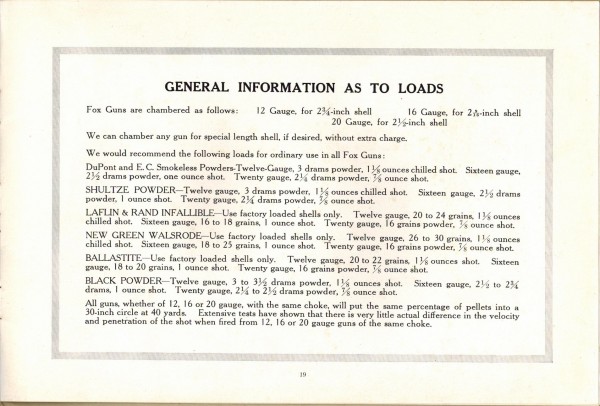
- 1914 A Fox Gets the Game catalog
That being said, virtually every 12-gauge Ansley H. Fox gun made in Philadelphia (other than the HE-Grade Super-Fox) that I've run a chamber gauge in shows about 2 5/8 - inch. The chambers of unmolested 16-gauge guns seem to run about 2 7/16 inch and 20-gauge guns a hair over 2 3/8 inch. A very few graded guns were ordered with longer chambers. I haven't searched the graded gun records for 16-gauge guns ordered for 2 3/4 inch shells, but there were eight or nine ordered chambered for 3-inch shells and a grand total of one ordered chambered for 2 7/8 inch shells ( see April 2012 Card of the Month). Savage began stating chambered for 2 ¾ inch shells in their 1938 Fox catalogues.
All this being said there is a good body of evidence that back in those days chambers were held about 1/8 inch shorter than the shells for which they were intended. In the book
The Parker Story the Remington vintage specification sheets on pages 164 to 169 call for a chamber 1/8-inch shorter than the shell for which it is intended. Also in the 1930's there were a couple of articles by A.P. Curtis in
The American Rifleman (July 1936 and March 1938) on the virtue of short chambers. A series by Sherman Bell in
The Double Gun Journal showed no significant increase in pressure from shooting shells in slightly short chambers. IMHO I don't much sweat that 1/8-inch in 12-gauge guns. On the other hand when one gets a 20-gauge chambered at 2 3/8-inch likely intended for 2 1/2-inch shells I do worry about folks firing 2 3/4-inch shells in such guns.
16-Gauge History lesson --
From the late 1890s until after WW-I, the heaviest 16-gauge loads our North American ammunition companies offered were 2 3/4 drams of bulk smokeless powder or 22 grains of dense smokeless powder such as Infallible or Ballistite, pushing 1 ounce of shot. Those loads could be had in the "standard" 2 9/16 inch case or any of the longer 2 3/4, 2 7/8 or 3-inch cases. In late 1922 or early 1923, Western Cartridge Co. added the 16-gauge to their progressive burning powder, high velocity loads called Super-X, but unlike the 1 1/4 ounce 12-gauge and 1 ounce 20-gauge Super-X loads which were put up in Western's 2 3/4 inch FIELD shells, the 1 1/8 ounce 16-gauge Super-X load was put up in their 2 9/16 inch FIELD shell. When the Lubaloy shot Super-X loads were introduced in July 1929, they were put up in Western's high brass RECORD shell, but the 16-gauge still in a 2 9/16 inch length case.
The 2 3/4 inch 16-gauge shell really began to get some traction when Remington Arms Co., Inc. introduced their Model 11 and "Sportsman" autoloaders in 16-gauge in 1931, chambered for 2 3/4 inch shells. While Remington's regular Nitro Express 16-gauge progressive burning powder load was put up in a 2 9/16 inch hull with a load of 3 drams equiv. pushing 1 1/8 ounce of shot, for their new 16-gauge autoloaders they introduced the slightly faster Auto-Express with a 3 1/4 drams equiv. charge pushing 1 1/8 ounce of shot --
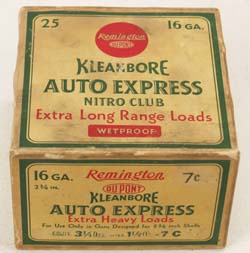
- 16-gauge Auto Express.jpg (22.22 KiB) Viewed 6794 times
I'm thin on Winchester ammo catalogues, but for sure by 1934, they were offering a similar 2 3/4 inch 16-gauge load.
The 2 3/4 inch Magnum shells with 1 1/2 ounce in 12-gauge, 1 1/4 ounce in 16-gauge and 1 1/8 ounce in 20-gauge first appear in the December 15, 1954, Western Cartridge Co. catalogues.
Western Cartridge Co. added a 2 3/4 inch 16-gauge to their Super-X offerings for 1938. From 1938 through 1942 they called this 16-gauge 2 3/4 inch Super-X shell "Magnum", even though it was still a 1 1/8 ounce payload. By Western Cartridge Co.'s March 7, 1946, catalogue the term "Magnum" was gone from this 2 3/4 inch 16-gauge Super-X shell. In Western's January 2, 1947, catalogue, the 2 9/16 inch 16-gauge Super-X shell was gone from both the chilled shot and the Lubaloy offerings, and their only 2 9/16 inch shells being offered were Xpert. This may have been an oversight, as the 2 9/16 inch 16-gauge Super-X shell with chilled shot is back in Western Cartridge Co.'s April 8, 1948, catalogue and price list, and the 2 9/16 inch 16-gauge Super-X loads remained until their last appearance on Western Cartridge Co.'s January 2, 1962, catalogue and price lists, where it is "available until stocks depleted." By Western Cartridge Co.’s January 2, 1963, catalogue and price lists the new Mark 5 was introduced and all the 16-gauge Super-X offerings are 2 3/4 inch. By the January 2, 1964, Western Cartridge Co. catalogue and price list the 16-gauge 2 9/16 inch Xpert shell is gone as well.